

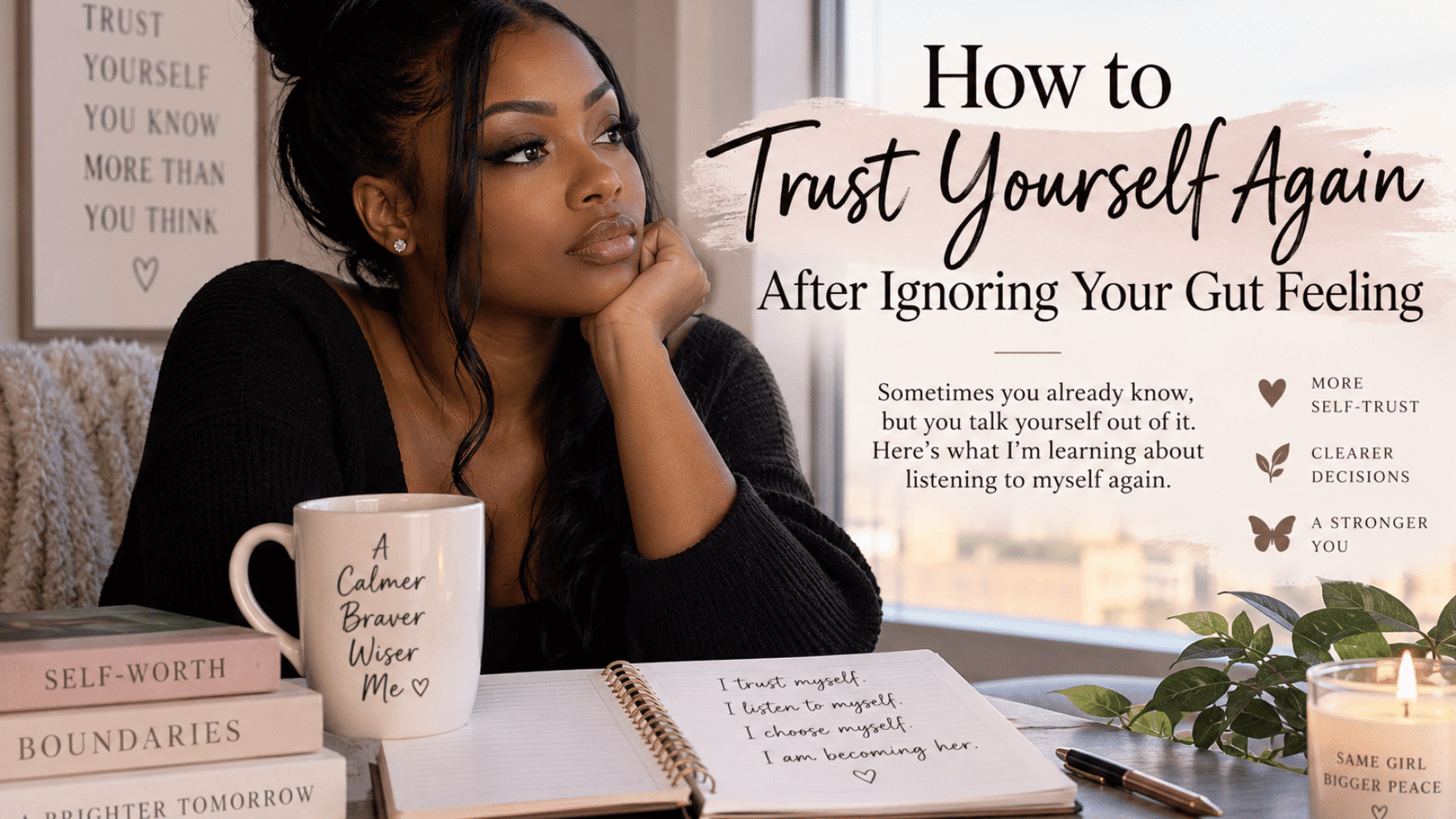
Learning how to trust yourself again can be hard when you know there were times you felt something was wrong and ignored it anyway.
I know that feeling.
There have been moments in my life when something did not sit right with me.
I felt it.
Looking for Simple Ways to Make Extra Money?
I keep a growing list of honest survey app reviews, cashback options, and beginner-friendly money ideas in one place. Visit my Ways to Make Extra Money Online page to explore realistic options that may fit your life right now.
I noticed it.
Part of me knew.
But then I started questioning myself.
Maybe I am overthinking.
Maybe I am being too sensitive.
Maybe I should give it more time.
Maybe things will change.
And sometimes they did not.
That is one of the hardest parts of learning to trust yourself again.
You have to stop being angry at yourself for what you did not understand yet.
You also have to start listening to yourself differently moving forward.
I am still learning how to do that.
Sometimes Your Gut Feeling Starts Quietly
I used to think a gut feeling had to be dramatic.
Like some huge voice inside you saying:
Get out. This is wrong.
But sometimes it is much quieter than that.
It can feel like discomfort.
Confusion.
A feeling that someone’s words and actions do not match.
A feeling that you are constantly explaining things away.
Maybe you keep saying:
“He probably didn’t mean it like that.”
“She is probably just having a bad day.”
“I should give this another chance.”
Sometimes those things are true.
Not every uncomfortable feeling means something terrible is happening.
But if the same feeling keeps coming back, I am learning not to dismiss it so quickly.
I Used to Question Myself More Than I Questioned the Situation
This is something I had to notice about myself.
When something felt wrong, sometimes my first reaction was not:
Why does this situation feel wrong?
Instead, I would think:
What is wrong with me for feeling this way?
That changes everything.
Because instead of looking at what is happening, you start putting yourself on trial.
Am I too emotional?
Am I expecting too much?
Am I being unfair?
Am I ruining something good?
There is nothing wrong with checking yourself.
I actually think self-reflection is important.
But there is a difference between self-reflection and constantly talking yourself out of your own feelings.
I am trying to learn that difference.
Trusting Yourself Does Not Mean You Will Always Be Right
This is important.
Learning how to trust yourself again does not mean believing every thought you have is automatically correct.
We can misread situations.
We can get scared.
We can misunderstand people.
That happens.
Trusting yourself means believing that your feelings are worth examining instead of automatically dismissing them.
You can say:
Something feels off. Let me pay attention.
You do not have to immediately make a huge decision.
You can observe.
Ask questions.
Look for patterns.
Give yourself time.
Trust is not about reacting to everything.
Sometimes it is about becoming willing to listen.
Pay Attention to Patterns, Not Just Promises
One thing I am trying to get better at is looking at patterns.
People can say almost anything.
“I’ll change.”
“I’ll do better.”
“It won’t happen again.”
“I care about you.”
Words matter.
But patterns matter too.
If someone’s words repeatedly do not match their actions, I think that deserves attention.
This applies to relationships, friendships, work, business opportunities, and many other parts of life.
I am learning not to build my decisions only around what someone says they are going to do.
I want to pay attention to what they actually do.
Stop Trying to Explain Away Every Red Flag
Sometimes we notice a red flag and immediately become the other person’s defense attorney.
Maybe they are stressed.
Maybe they had a bad childhood.
Maybe they do not know how to communicate.
Maybe they are scared.
Maybe they have never had someone like me before.
There may be a reason behind someone’s behavior.
But a reason is not always the same thing as an excuse.
Understanding why someone does something does not mean you have to accept the way it affects you.
That is something I am still learning.
Compassion for someone else should not require abandoning yourself.
Ask Yourself How You Feel Around the Situation
Sometimes I think we focus so much on whether someone is technically doing something wrong that we forget to ask a simpler question:
How do I feel around this person or situation?
Do I feel calm?
Do I feel respected?
Do I feel confused all the time?
Do I feel like I have to walk on eggshells?
Do I constantly have to convince myself that everything is okay?
Do I feel like I am becoming less like myself?
Those questions matter.
Your feelings are not always proof of someone’s intentions.
But they can give you information about your experience.
And your experience matters too.
Give Yourself Permission to Slow Down
One way I am learning to trust myself is by not rushing every decision.
When I am excited about something, I can want to see the best in it.
When I am scared, I can want to fix everything immediately.
Neither one always helps me make the clearest decision.
Sometimes I need to slow down.
Sleep on it.
Watch what happens next.
Give myself enough time to see whether someone’s behavior stays consistent.
The truth usually becomes clearer with time.
Keep Small Promises to Yourself
I think self-trust is built the same way trust with another person is built.
Through consistency.
If you constantly tell yourself:
“I am never doing this again.”
Then do it again.
Or:
“I am going to take care of this tomorrow.”
Then avoid it for weeks.
You may slowly stop believing yourself.
I am trying to rebuild that in smaller ways.
If I tell myself I am going to work on something today, I try to do it.
If I say I need a break, I try to give myself one.
If I notice something does not feel right, I try not to immediately shut that feeling down.
Those small moments can help rebuild confidence.
You Are Allowed to Change Your Mind
This has been another lesson for me.
Sometimes I have felt like if I said yes once, I had to keep saying yes.
But you are allowed to learn new information.
You are allowed to realize something is not right for you.
You are allowed to change your mind.
You are allowed to say:
I thought this was what I wanted, but now I don’t.
That does not automatically make you flaky or difficult.
Sometimes changing your mind is evidence that you are finally listening to yourself.
Stop Waiting for Someone Else to Confirm What You Already Know
Sometimes we already know something does not feel right, but we want another person to confirm it.
We ask friends.
We ask family.
We search online.
We replay conversations.
We keep looking for someone to say:
“Yes. You are right.”
I understand why.
Validation feels safe.
But I am learning that sometimes I need to become comfortable saying:
This does not feel right for me, and that matters.
I do not need everyone else to agree before I take myself seriously.
Forgive Yourself for the Times You Didn’t Listen
This might be the hardest part.
It is easy to look back and think:
I knew better.
Why did I stay?
Why did I ignore that?
Why did I give another chance?
Why didn’t I walk away sooner?
I have had to remind myself that hindsight makes everything look obvious.
It usually was not that obvious when you were living through it.
You had emotions.
Hope.
Fear.
Attachment.
Questions.
You were making decisions with the information and understanding you had at the time.
That does not mean you cannot learn from it.
It just means you do not have to punish yourself forever.
Self-Trust Grows Every Time You Choose Yourself
Learning how to trust yourself again is not one big moment.
I think it happens through a lot of little decisions.
The moment you stop explaining away something that repeatedly hurts you.
The moment you ask another question instead of pretending you are fine.
The moment you leave something that no longer feels right.
The moment you admit you made a mistake without deciding that you are a mistake.
The moment you listen to yourself.
Every time you do that, you are showing yourself:
I will not abandon you.
I think that matters.
I Am Still Learning Too
I do not want to write this like I have completely mastered self-trust.
I haven’t.
There are still times when I second-guess myself.
There are still times when I want reassurance.
There are still situations where I have to remind myself to pay attention to what I am feeling.
But I think I am getting better.
I am learning that I do not need to be perfect at reading people.
I just need to stop automatically assuming everyone else knows better than I do.
I can listen.
I can observe.
I can ask questions.
I can make a decision.
And if I make the wrong one, I can learn from it.
You Can Learn to Trust Yourself Again
If you have ignored your gut feeling before, it does not mean you will always do it.
If you stayed too long, that does not mean you cannot leave sooner next time.
If you overlooked red flags, you can learn to recognize them earlier.
If you made a decision you regret, you can make a different decision moving forward.
You do not rebuild self-trust by becoming someone who never makes mistakes.
You rebuild it by knowing that even when you make a mistake, you will listen, learn, and take care of yourself afterward.
That is what I am working toward.
Not perfection.
Just becoming a woman who trusts herself a little more than she did before.
And I think that is another important part of Becoming Antoinette.
Leave Your Comment